For decades, denim has enjoyed a status few fabrics can claim: timeless, democratic, and deeply woven into global culture. From workwear to luxury runways, the world’s love affair with jeans shows no signs of slowing. Billions of pairs are made and sold every year a testament to denim’s extraordinary reach across generations, geographies, and income brackets.
Yet beneath this iconic status lies a far more troubling reality. The denim industry, like much of the broader textile sector, operates on a linear “take-make-waste” model that depletes resources, pollutes ecosystems, and accelerates climate change. As demand for cheap, fast-turnover fashion grows, so too does the environmental pressure. Circularity is no longer a “nice to have” it is central to the survival of the planet and the future of fashion.
The Hidden Cost of Denim
Though denim is celebrated as durable and long-lasting, its production is highly resource-intensive.
Three Big interconnected challenges explain why denim has such a large ecological footprint:
The Textile Sector’s Climate Burden
According to the European Environment Agency’s 2025 briefing on EU textiles circularity, textile consumption in Europe in 2022 generated approximately 355 kg of CO₂ equivalent emissions per person comparable to driving 1,800 km in a standard petrol car.EEA 2025 In total, this amounts to 159 million tonnes of CO₂e across the EU’s textile supply chain in a single year. Textiles rank as the sixth largest household consumption category for climate impact, behind only housing, food, and mobility.
Denim, with its multi-stage, chemically intensive lifecycle, sits among the highest-emission categories within this sector. A single pair of conventional jeans requires up to 7,500 litres of water to produce,UN / CBC and the dyeing and finishing processes generate toxic wastewater that contaminates rivers across South and East Asia.
Clothing Waste and Low Recycling Rates
The scale of textile waste is staggering. In Europe, between 4% and 9% of all textile products put on the market are destroyed without ever being used — a direct consequence of overproduction and costly returns management.EEA In 2022, EU Member States generated approximately 6.94 million tonnes of textile waste, with 85% of household textile waste failing to be separately collected, ending up instead in mixed waste streams destined for landfill or incineration.EEA 2025
Globally, the picture is even more troubling. The Ellen MacArthur Foundation’s landmark 2017 report A New Textiles Economy found that 87% of the total fibre input used for clothing is ultimately landfilled or incinerated representing a resource loss of over USD 100 billion annually.EMF 2017 Only about 20% of discarded textiles globally are collected for any form of reuse or recycling and of that collected fraction, less than 1% is recycled into new garments.EMF 2017
The primary barrier has long been technological: recycling mixed-fibre textiles back into virgin-quality yarn has not been feasible at scale. The result is a system where most materials lose value immediately after a single use, reinforcing linearity at every stage of the chain.
Minimal True Recycling
Less than half of used garments are collected, and only 1% are recycled back into new clothing. The primary barrier is technological: until recently, recycling fibers back into “virgin-like” quality has not been feasible at scale. The result is a system where most materials lose value and cannot be recirculated, reinforcing linearity.
The EU’s Pivotal Role: Driving a Global Transformation
The EU – home to the world’s largest textile market – has emerged as the most ambitious policy driver for circular textiles. Its Strategy for Sustainable and Circular Textiles, updated through 2024–2025, aims for a fully circular textile sector by 2030, centered on durability, repairability, zero waste, and toxin-free production.
By late 2025, several major policies have been finalized or advanced, and they are reshaping industry expectations worldwide:
Textile Waste Regulations (Adopted September 2025)
Producers must now finance the collection, sorting, and recycling of textiles under Extended Producer Responsibility (EPR). By 2028, EU countries must implement separate textile waste streams, directly addressing the 5.8 million tonnes of annual textile waste. This is one of the most influential waste reforms globally, and it pressures international suppliers to comply.
Ecodesign for Sustainable Products Regulation (ESPR)
The ESPR 2025–2030 working plan prioritizes textiles, mandating:
- Minimum durability and repairability standards
- Mandatory recycled content (up to 25% by 2030)
- Digital product passports for traceability
These rules mean jeans will need to last longer, contain more recycled fiber, and provide transparency on where and how they are made.
Revised Textile Labelling Requirements (October 2025)
New EU labelling requirements under revision mandate clear, verifiable sustainability information. Greenwashing claims are prohibited, and product labels must indicate fibre composition, recyclability, and country of origin. These rules work in tandem with the ESPR’s Digital Product Passport framework to give consumers and recyclers access to accurate end-of-life information.
Industrial Investment and Policy Alignment
To support these regulatory ambitions, the European Commission formalised in March 2025 the Textiles of the Future European Partnership under Horizon Europe, committing at least €60 million from public and private stakeholders between 2025 and 2027 to collaborative textile research and innovation projects.Textile ETP The partnership focuses on accelerating sustainability, circularity, and digital innovation in the EU textile sector. Trade policies also link access to the EU market with sustainability compliance, creating significant pressure on global supply chains to align with these standards.
How the Denim Deal Fits Into This Global and EU-Led Landscape
The Denim Deal, launched in the Netherlands on 29 October 2020, was among the world’s first sector-specific circularity initiatives of its kind. A public-private partnership funded by the Dutch Government and aligned with the EU Green Deal and Circular Action Plan, it brought together brands, retailers, manufacturers, recyclers, collectors, and public authorities around a shared mission: to close the loop in denim production by scaling the use of post-consumer recycled (PCR) cotton.
The Dutch initiative set two core goals: that participating brands achieve a minimum of 5% PCR content across their denim collections, and that the signatories collectively produce three million pairs of jeans containing at least 20% PCR cotton by December 2023.
Dutch Denim Deal (2020–2023): Key Results
The three-million-pair target requiring ≥20% PCR cotton was surpassed as early as 2021, with 2022 seeing total production by signatories exceed five million such pairs.Sourcing Journal
The share of jeans brought to the Dutch market with a minimum of 20% PCR content rose from 8% in 2020 to 41% by 2022, while internationally 53% of jeans produced by signatories met the same threshold.Sourcing Journal
The initiative concluded in 2023 with 53 signatories manufacturers, brands, collectors, recyclers, and public bodies having demonstrated at industrial scale that circular denim production is commercially viable.
The results were significant not just for their numbers, but for what they disproved: the long-held industry assumption that post-consumer recycled cotton would compromise garment quality and brand positioning. The Dutch Denim Deal served as a proof of concept for circular denim at scale.
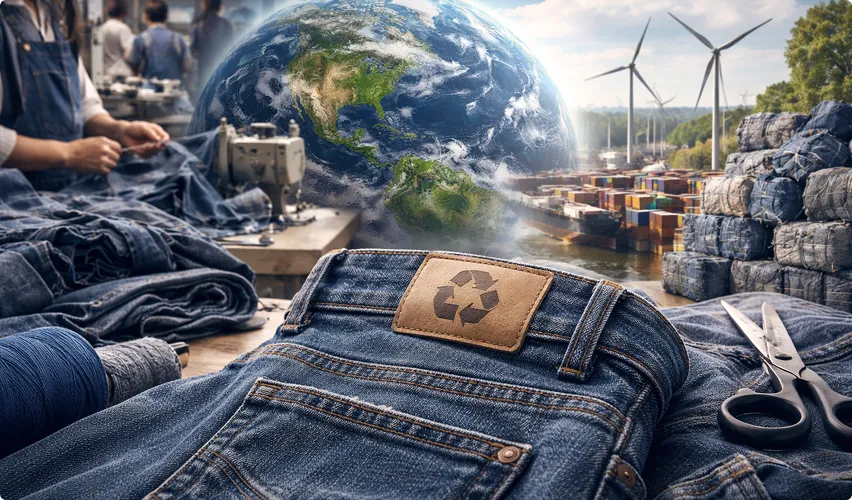
India: Poised to Become the Next Global Hub for Sustainable Denim
India is the world’s second-largest producer of denim fabric by installed capacity, with infrastructure exceeding 1,600 million meters annually second only to China.TexFash 2026 Domestic consumption accounts for approximately one billion meters per year, with hundreds of millions more exported to markets in the EU, the US, and beyond. Gujarat is the epicentre of this production, contributing an estimated 60–70% of national denim fabric output, supported by proximity to India’s cotton belt and a large ecosystem of vertically integrated mills.
With this scale comes an equally significant waste stream and, increasingly, the infrastructure to address it. The launch of the Denim Deal India Hub on 8 September 2025 marks a turning point. Created through a formal partnership between the Global Alliance for Textile Sustainability Council (GATS), Enviu, and the Denim Deal Foundation, the Hub aims to build a functional circular supply chain for PCR cotton across India’s denim industry connecting collectors, sorters, recyclers, and manufacturers under a shared certification and traceability framework.Enviu 2025
Here’s how India can accelerate its rise:
Build Circular Infrastructure and Recycling Technology
Reverse supply chains: With Recyclr, GATS, and Enviu already processing thousands of tonnes of waste, India can scale collection nationwide and hit 20% PCRC by 2030.
Mechanical and enzymatic recycling can reduce water use from 7,500 liters per pair to below 2,000.
Government incentives under the National Textile Policy 2025 can speed up low-impact dyeing and recycling technologies.
Align Policies with Global Standards
Implementing domestic EPR systems mirrors EU rules and ensures smoother access to export markets.
Establishing sustainable textile clusters in Tamil Nadu and Gujarat could attract up to $10 billion in investment by 2027.
Strengthen Collaboration and Workforce Skills
Partnerships with Denim Deal members like PVH and Soorty can accelerate traceable, circular collections.
Training 1 million workers in sustainable manufacturing and digital traceability will create high-value green jobs.
With these moves, India could capture 30% of the global sustainable denim market, projected at $50 billion by 2030, while reducing the sector’s significant share of national emissions.
As the world finally confronts the hidden cost of its most beloved fabric, the Denim Deal signals a global shift from destructive linearity to purposeful circularity – and with its scale, skill, and ambition, India now stands at the front line of this transformation, ready to turn the crisis of denim into the biggest opportunity the fashion industry has seen in decades.
Sources
- https://www.eea.europa.eu/en/analysis/publications/circularity-of-the-eu-textiles-value-chain-in-numbers
- https://www.eea.europa.eu/en/circularity/sectoral-modules/textiles/greenhouse-gas-emissions-from-eus-textiles-consumption
- https://www.cbc.ca/radio/ideas/how-jeans-became-one-of-the-most-polluting-garments-in-the-world-1.5280773
- https://www.eea.europa.eu/en/topics/in-depth/textiles
- https://content.ellenmacarthurfoundation.org/m/6d5071bb8a5f05a2/original/A-New-Textiles-Economy-Redesigning-fashions-future.pdf
- https://www.europarl.europa.eu/topics/en/article/20201208STO93327/fast-fashion-eu-laws-for-sustainable-textile-consumption
- https://www.carbonfact.com/blog/policy/espr-textile
- https://euratex.eu/news/european-commission-boosts-textile-innovation-with-launch-of-a-dedicated-funding-programme-the-european-partnership-for-textiles-of-the-future/
- https://www.textile-platform.eu/textiles-of-the-future
- https://afvalcirculair.nl/textiel/green-deal-circular-denim/
- https://wwd.com/sourcing-journal/sj-denim/peaks-pitfalls-dutch-denim-deal-recycling-initiative-bossa-1238827454/
- https://texfash.com/column/beyond-the-blue-thread-india-s-expanding-footprint-in-the-global-denim-economy
- https://news.enviu.org/254012-denim-deal-launches-india-hub-in-partnership-with-gats-and-enviu/
Related Insights




Get Our Latest Newsletter Direct To Your Mailbox
Subscribe Now